This anecdote became the basis for my book, Howlers: Lupus Rex. It happened in January 1983 while I was in Orlando, attending the Navy’s Nuclear Power School. This is what really happened, not what I put in the book for cinematic purposes.
Having grown up in the piney woods and high swamps of northern Louisiana, I found myself wishing more often than not that I could get away from the city. Somewhere quiet. Somewhere with trees. Somewhere I could kick back with a few friends, drink a couple of beers, and relax. Orlando was driving me bonkers. Too much traffic. Too much concrete. Not enough sky. I asked my roommates, Rick and Tracy, if they’d be interested in something like that, and they jumped at the chance.
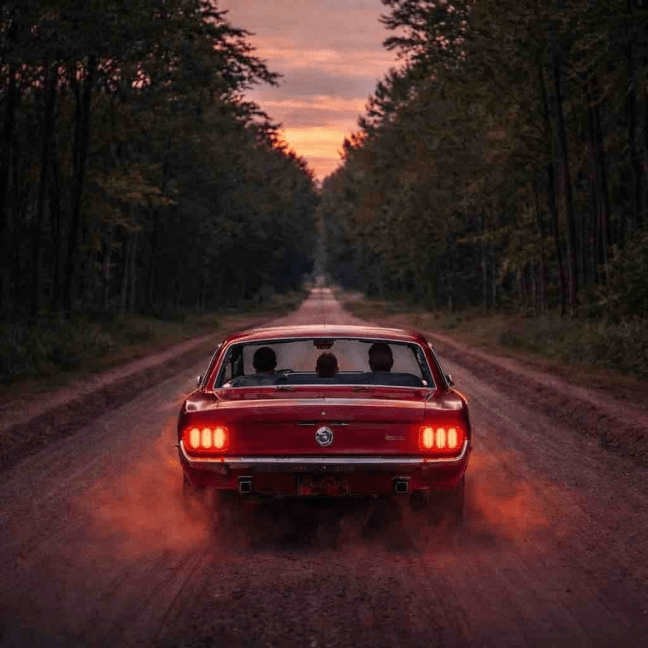
One Saturday night, the three of us loaded into my dilapidated ’66 Mustang Lil’ Red and went looking for a place outside the city where we could do just that.
We bought a twelve-pack of Budweiser and started exploring back roads around Orlando. After about an hour of hitting every little side road we could find, we came across a dirt road somewhere to the west that disappeared into the woods like a fishing line slipping into a bayou. I don’t remember the exact location, and I’m not even sure it was west, but that’s how it’s always sat in my memory. It was dusk by then. I don’t remember exactly where the sun was, and I doubt I could have found that road again the next day. After what happened, I’m not sure I’d have wanted to.
We followed the dirt road for a couple of miles, pushing deeper into the woods. It had good drainage ditches on both sides and was wide enough for two cars to pass. The trees were tall and close, blocking out any sense of where we were. A red fog filled my rearview mirror as my taillights reflected off the dust Lil’ Red kicked up. We could only see forward. If it hadn’t been for the thin, silvery strip of sky overhead, I’d have thought we were driving through a tunnel.
For a dirt road, it was well maintained. We assumed it would eventually open into a field or clearing. Instead, it ended at a locked metal gate made of pipe, with a rusty chain and a crooked No Trespassing sign hanging on it.
The dark seemed to close in when we realized we weren’t going any farther. I knew we were well outside town because the radio station I usually listened to faded in and out like there was a loose wire under the dashboard.
We’d reached the end of our journey.
With trees blocking any view to the sides, all we could see were the stars overhead and the road stretching back the way we’d come. The road past the gate curved out of sight. We decided to build a fire—partly for warmth, partly for light. It was still a little chilly, and I didn’t trust Lil’ Red to keep the lights on with the engine off.
We gathered wood and built the fire right there on the road. We were close enough to the ditch to let traffic pass, though looking back, that probably should have stopped us. Build a fire on the road? Stupid kids. Anyway, the gate looked like it hadn’t been opened in years, which struck me as odd. Why maintain a road to a gate nobody used? I briefly wondered if it was the longest private driveway I’d ever seen.
After about twenty minutes, we had a roaring fire, flames reaching about waist-high on me. I’m 5′ 10″ in cowboy boots. Rick and I sat on the trunk while Tracy tended the fire. We drank a couple of beers, told dirty jokes, and had ourselves a fine time.
Then things went preternatural.
From somewhere deep in the woods came a series of howls—two or three voices. I’d heard wolves. I’d heard coyotes. I’d heard humans trying to imitate both. This wasn’t any of those. Something old and buried in our genetic memory snapped awake, and just like that, I was the leader, because Rick and Tracy were looking to me for the answer to whatever the hell that was.
“It’s probably just wild dogs,” I said, mostly for their benefit. I suggested we build the fire higher. “Fire keeps animals away,” I said, mostly for my benefit. We all felt better once the flames climbed above our heads.
Then we heard the howls again—closer this time. Based on running coon dogs, I guessed they were about half the distance they’d been before. Still not on top of us, but definitely coming our way. They should have turned when they smelled the smoke.
I turned the car around, just in case, and grabbed my Walking Tall stick from the back seat. We were hardheaded. We wanted to enjoy our fire, and wild critters were not going to run us off.
The firelight, the smoke, and the beer settled us again. We joked and opened fresh beers. About halfway through mine, we heard growling and howling from our side of the road—and then from the other.
We were surrounded.
Those sounds weren’t meant to scare us, though they certainly did. They were communicating. I don’t know how I knew that, but I did.
Either another pack had come up behind us, or the original pack had split up. They were fast and quiet. We hadn’t heard them until they wanted us to. Whatever they were, they were moving through the woods toward us, and they weren’t hiding it. I felt like a deer being worked by hounds. The logical part of my brain yelled prank. The caveman part yelled run.
The caveman won.
I hollered, “Get in the car!” Tracy scrambled into the back seat while I started the engine. The woods erupted with movement and sound. Rick froze, afraid to run to the passenger side nearest the trees. He yelled for me to get out so he could crawl over the driver’s seat. I declined using some choice Navy language and told him to crawl over me. Nothing was getting me out of that damned seat. He came through the window like a squirrel into a knot hole. His legs were still hanging out when I punched the gas.
About thirty yards down the road, curiosity got the better of me. I had to know, so I slowed, and we all looked back.
Three of the largest wolves I have ever seen leapt out of the trees into the spot where we’d been standing. They didn’t run. They jumped ten yards, easy. Firelight caught them through the dust. One crossed in front of the flames, its back coming within a foot of the top of the fire. That fire was nearly six feet tall.
Then, as if on some unheard cue, they turned and ran after the car.
I punched it again.
The rest of the drive was quiet other than the rattling exhaust pipes. When we spoke, it was only to confirm what we’d seen. There was no disagreement. We hadn’t imagined it. We hadn’t misunderstood it. We’d encountered something that didn’t fit the natural order as we understood it, and we’d barely gotten away. Seeing the lights of Orlando felt like surfacing for air.
I don’t know how it affected Rick or Tracy, but my mind wouldn’t let it go. I’m a logical person. I’m used to thinking my way through problems. This one wouldn’t cooperate. I kept pecking at it like a woodpecker on a telephone pole, and the more I pecked, the worse it tasted.
Did we just encounter werewolves?
The logical part of my mind said no. Flatly. The caveman didn’t care about definitions. He only knew he didn’t want to go back. I briefly tried to convince myself they were human. That didn’t last. Humans don’t jump like that. They don’t move like that. They don’t communicate like that. Whatever we saw had intelligence and animal cunning, but it wasn’t human—and I don’t believe it was animal either. It was something in between.
Something like that should have shattered my worldview. It didn’t.
That bothered me more than the encounter itself.
Why didn’t it? Are there things out there our genetic memories know of, but keep hidden until we need them? I wish I knew the answer.
I wrote that passage over ten years ago. I had no definition for what we were feeling.
However, just a year or so ago, I stumbled over something new that explained it perfectly.
Ontological Resilience is the ability of people and communities to absorb something that should shake them and still keep their footing. It’s how you face something that threatens your understanding of the world without letting it tear you apart.
With that in mind, I can finally explain the rest of our journey and why what we saw didn’t shatter our worldview.
As we drove, the fear changed. It dulled. It settled. It stopped being sharp and became heavy, manageable. Not panic. Not relief. Something steadier. Recognition. If creatures like that existed, then they hadn’t just appeared. Things like that leave marks. They shape behavior.
Which meant our ancestors must have known them.
Somewhere along the line, people learned when not to go out. Which places to avoid. Why certain warnings were framed as superstition instead of explanation. They built lives that worked around the problem. Over time, the reason blurred, but the behavior stuck. Then even the behavior faded, and all that was left was the story. And eventually, the story became a joke.
That thought settled me more than I expected.
By the time the trees thinned and the streetlights appeared, the fear had turned into something almost respectful. The town looked the same as ever—porch lights, gas stations humming, cars coming and going. Civilization doing what it does best: pretending it has always been alone.
We didn’t feel crazy. We didn’t feel special.
Mostly, we felt late.
Late to a truth people once understood well enough to survive alongside, and then quietly decided not to remember.
And as we drove the last few blocks in silence, one thought kept circling back, uninvited but oddly reassuring: If humans had lived with things like that before, then surviving wasn’t a miracle. It was a skill we’d simply forgotten how to talk about.
Once I was able to put all of that together, I wondered what the true difference was between imagination and logic. Because if those weren’t werewolves, why did my mind want to think that? My first attempt to define logic vs. imagination can be found here, but it was this anecdote that started me down that path decades ago.
Human beings are born into a reality with gaps in understanding. Children fill those gaps through creative interpretation, producing monsters and fantastical beings as symbolic descriptions of the unknown. As maturity progresses, creativity is constrained by logic—not because it is less real, but because logic is more socially and functionally efficient. Both creativity and logic describe reality rather than define it; one preserves meaning, the other enables operation. Children believe in monsters not because they misunderstand reality, but because they have not yet been taught which parts of it to ignore.
 Tom Bont's Silver Key