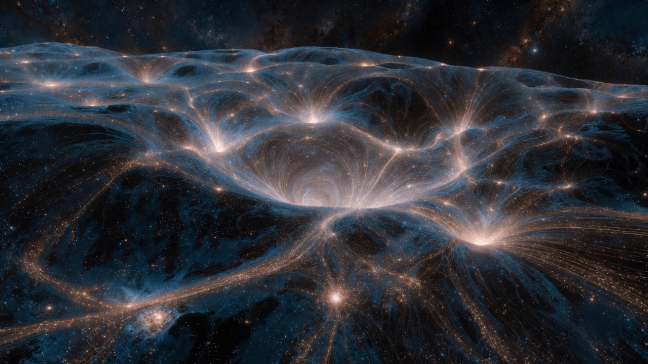
The Quantum Entanglement Cosmology (QEC) Theory posits that the universe functions as a closed-loop gravitational system in which black holes act not as destructive endpoints, but as “intake nodes” in a vast, quantum-entangled network woven through spacetime foam. Matter and energy drawn into a black hole do not cease to exist; instead, they are channeled through nonlocal spacetime bridges—topologically folded regions of entangled quantum geometry. These bridges allow for the eventual re-emergence of that matter and energy, not through singular white holes, but via distributed, subtle emergence events that span time and space.
These emergence points are non-singular and rarely detectable, appearing instead as natural phenomena: spontaneous star formation, anomalous dark matter accumulations, high-energy particle ejections, or seemingly uncaused quantum vacuum fluctuations. Critically, these emergence events evade direct observation. Drawing on principles of quantum decoherence, the theory holds that interactions with the surrounding environment—such as ambient fields or matter—collapse potential emergence events, either preventing them or displacing them elsewhere. Emergence thus favors unmeasured, decoherent conditions—regions of space-time with low informational density and minimal environmental interference.
A central feature of QEC is temporal dislocation. The theory asserts that matter entering the entangled network does not reemerge in synchronicity with its intake. Instead, the temporal offset can range from milliseconds to millions of years. This decoupling is governed by the internal geometry of the network itself, which exists outside linear causality. As a result, material swallowed by a black hole today might reappear in a distant region of the universe’s past or future. This redistribution is not random, but probabilistically shaped by gravitational stress, spacetime curvature, and local entropy gradients.
Wormholes, within this framework, are understood as rare and unstable expressions of the entangled network. Most are non-traversable and remain undetected. However, under exceptional conditions, some wormholes may briefly manifest as observable anomalies—gravitational echoes, radiation scars, or exotic matter trails. A few may allow one-way or two-way transport, while others might permit only the one-shot, one-way exchange of information or quantum states. The theory suggests that such wormholes are not engineered corridors, but spontaneous breaches in the network caused by accumulated tension or geometric interference. Their locations, durations, and endpoints are inherently unpredictable.

An artist’s impression of Quantum Entanglement Cosmology: matter enters the node, travels the hidden channels, and re-emerges — distributed, decohered, and delightfully unpredictable.
QEC maintains that mass-energy is conserved across the universal whole. The entangled network ensures that what is taken in is eventually returned, even if separated by billions of years or vast stretches of space. This balance is preserved without requiring external input, indicating a self-regulating cosmological architecture. Dark matter may be a side-effect of partial emergence—residual structures of reintroduced material that remain weakly interactive due to incomplete decoherence. Likewise, anomalies in the cosmic microwave background may reflect turbulence caused by distant or ancient emergence events. In total, the Quantum Entanglement Cosmology Theory presents a universe that is not static, linear, or wholly observable, but instead dynamic, recursive, and reflexively evasive. Observation itself defines the visible edge of causality. Beyond that edge, matter and energy slip through hidden entangled channels—draining from one era, reappearing in another, watering the roots of time itself.
Excerpt from Warp Space: Science Fiction Roleplaying, Secrets of the of Ishara by Tom Bont.
 Tom Bont's Silver Key